An Introduction to the CQRS Pattern
2025-09-09 • 5 min read
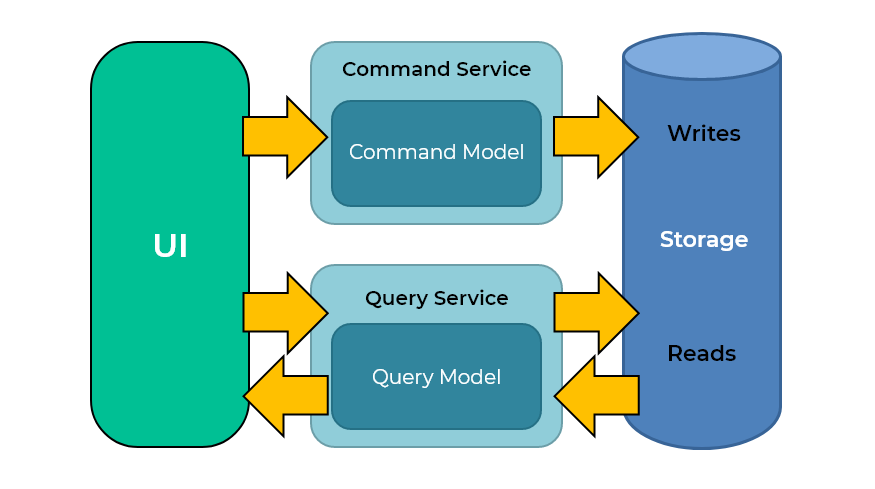
CQRS, which stands for Command Query Responsibility Segregation, is an architectural pattern that separates the process of changing application state from the process of reading application state. Instead of using a single conceptual model for both updating and retrieving data, CQRS advocates for two distinct models:
- The Command Model: This model is responsible for handling all operations that modify data or change the system's state. These operations are referred to as "Commands." Examples include creating a new user, updating a product's price, or submitting an order.
- The Query Model: This model is dedicated solely to retrieving and displaying data. These operations are known as "Queries." Examples include fetching a user's profile, listing all available products, or viewing order history.
At its core, CQRS is based on the principle that the methods for writing data and reading data have fundamentally different requirements and can be optimized independently.
Why Use the CQRS Pattern?
Adopting the CQRS pattern can introduce significant benefits, particularly in complex or large-scale applications. The primary advantages are related to scalability, flexibility, and the simplification of the domain model.
1. Improved Performance and Scalability
In many applications, the workload for reading data is vastly different from the workload for writing it. For instance, an e-commerce platform will have a much higher number of users browsing products (reading) than users making purchases (writing).
CQRS allows these two sides of the application to be scaled independently. You can allocate more resources to the query infrastructure to handle high read traffic without impacting the performance of the command side. Furthermore, it enables the use of different database technologies for each model. The command side might use a normalized SQL database to ensure data consistency, while the query side could use a denormalized view, a document database, or a search index optimized for fast lookups.
2. Enhanced Flexibility and Simplified Models
A single model responsible for both commands and queries can become overly complex. It must handle business logic, validation, and authorization for write operations while also being structured to efficiently serve data for various views and user interfaces.
By separating these concerns, each model becomes simpler and more focused:
- The Command Model can focus exclusively on executing business rules and ensuring data integrity. It doesn't need to be concerned with how data is formatted for presentation.
- The Query Model can be tailored to the specific needs of the user interface. You can create highly optimized, denormalized data structures (views) that directly map to what the user sees, avoiding complex joins or calculations during a read request.
When to Implement CQRS
CQRS is a powerful solution, but it also introduces additional architectural complexity. It is not suitable for all applications. Consider using CQRS in the following scenarios:
- Complex Business Domains: In systems with intricate business logic and validation rules, CQRS helps manage this complexity by isolating the command logic from the query logic.
- High-Performance Applications: When an application requires high availability and low latency, especially for read operations, CQRS provides the necessary separation to optimize and scale the read and write models independently. This is common in systems with high-traffic dashboards, real-time analytics, or social media feeds.
- Collaborative Environments: Applications where multiple users interact with the same data concurrently, such as in content management systems or collaborative editing tools, can benefit from the explicit separation of commands and queries.
When to Avoid CQRS
For simple applications, particularly those that primarily perform basic Create, Read, Update, and Delete (CRUD) operations, CQRS is often unnecessary. The added complexity of maintaining separate models, data stores, and the data synchronization mechanism between them can outweigh the benefits. In such cases, a traditional, unified data model is often more straightforward and efficient to develop and maintain.