Building a Resilient Scraper with RabbitMQ and RxJS
2025-09-10 • 10 min read
Web scraping at scale is a tricky business. A single scraper script running on one machine might work fine for small tasks, but once you’re handling dozens or even hundreds of concurrent jobs, you’ll quickly face challenges:
- Browser instances crashing.
- Target websites throttling or blocking requests.
- Floods of error logs spamming your monitoring channel.
- Queued messages looping endlessly when workers can’t process them.
In this article, I’ll share how I built a resilient scraper system powered by RabbitMQ for message-driven orchestration and RxJS for concurrency control and backpressure handling.
The Architecture
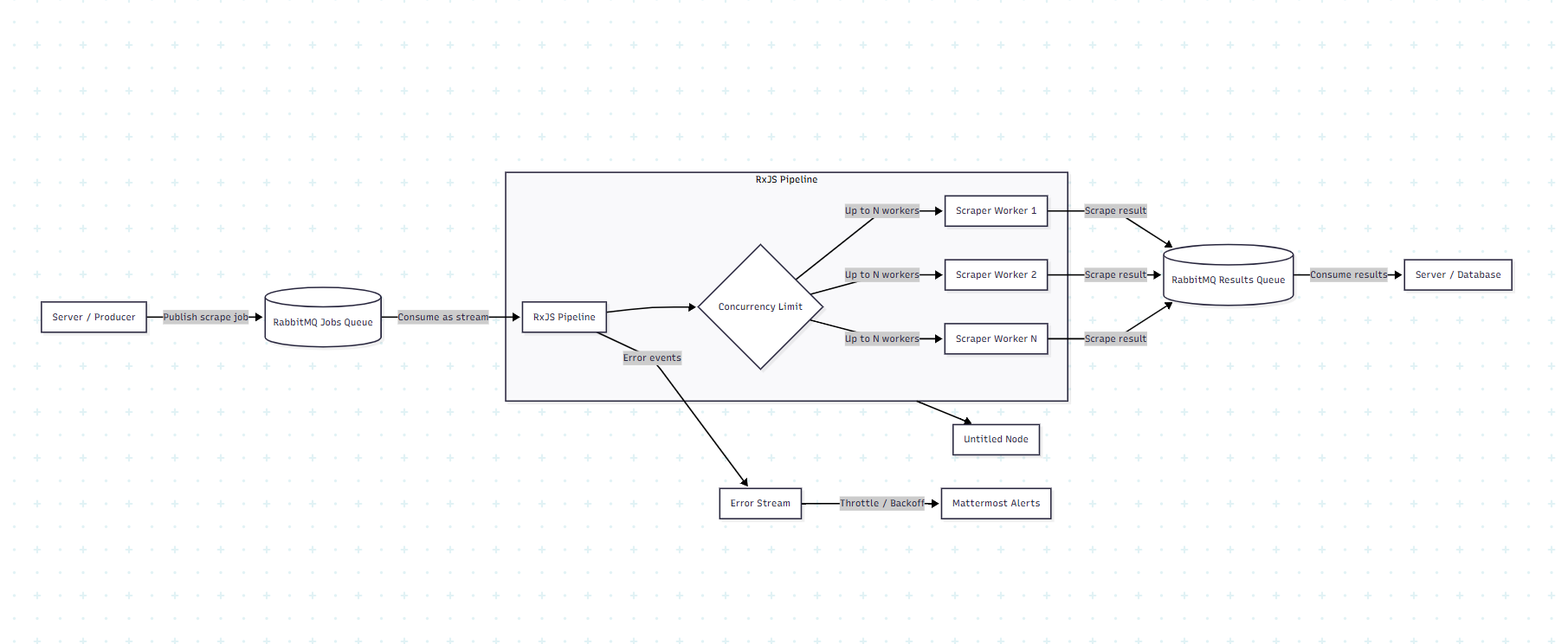
Here’s the high-level workflow:
-
Server / Producer
- Produces scraping jobs to RabbitMQ.
- Each job contains metadata: target URL, scraping config, client ID, etc.
-
Scraper Service / Consumer
- Consumes messages from RabbitMQ.
- Spawns multiple Chromium browser instances to run the scraping tasks.
- Before starting, it checks VM/browser availability via an API.
- If the system is busy or an error occurs, it requeues the message.
-
Result Handling
- Once scraping finishes, results are pushed back to RabbitMQ.
- Server consumes them and persists to the database.
This separation ensures loose coupling and scalability. The scraper service can run on multiple machines, consuming from the same queue.
The Challenge
Initially, this setup worked fine. But as the system scaled, problems emerged:
-
UnavailableBrowser Flood When browser instances were maxed out, RabbitMQ kept sending more jobs, which instantly failed and requeued. Logs exploded with error spam.
-
Requeue Loops If a job failed due to a transient error, it could get stuck in an infinite requeue cycle.
-
Concurrency Pressure Running too many browser instances at once caused memory spikes and system crashes.
Clearly, raw consumers weren’t enough, we needed smarter concurrency control.
The RxJS Solution
RxJS (Reactive Extensions for JavaScript) is a library for handling asynchronous data streams. In this scraper system, I used RxJS to:
- Control concurrency limits (number of jobs running at the same time).
- Implement backoff strategies when errors repeat.
- Throttle logs to avoid spamming.
- Pause consumption temporarily when resources are exhausted.
Implementation Walkthrough
1. Consuming Messages as a Stream
Instead of handling RabbitMQ messages in a simple callback, I converted them into an RxJS observable stream:
tsimport { fromEvent } from "rxjs"; import { mergeMap, catchError } from "rxjs/operators"; // Assume channel is RabbitMQ channel const message$ = fromEvent(channel, "message"); message$ .pipe( mergeMap(async (msg: any) => { const job = JSON.parse(msg.content.toString()); await processScrapeJob(job); channel.ack(msg); }) ) .subscribe();
Here, mergeMap controls concurrent execution.
2. Limiting Concurrency
If I only want 5 scraping jobs running at a time, I set the concurrency parameter:
tsmergeMap((job) => processScrapeJob(job), 5);
This prevents overload by ensuring at most 5 browser instances are active simultaneously.
3. Handling Repeated Errors with Backoff
If I hit repeated "UnavailableBrowser" errors, I don’t want to instantly retry and flood logs. Instead, I pause consumption for 5 minutes:
tsimport { timer } from "rxjs"; let errorCount = 0; function handleError(err: Error) { if (err.message === "UnavailableBrowser") { errorCount++; if (errorCount >= 3) { console.log("Pausing queue for 5 minutes..."); channel.pause(); // pseudo-code timer(300000).subscribe(() => channel.resume()); errorCount = 0; } } }
This introduces a circuit-breaker pattern using RxJS timers.
4. Throttling Error Logs
To avoid flooding Mattermost with the same error:
tsimport { throttleTime } from "rxjs/operators"; message$ .pipe( catchError((err) => { errorStream.next(err); // push error into a separate stream throw err; }) ) .subscribe(); errorStream.pipe(throttleTime(60000)).subscribe((err) => { sendToMattermost(err); // log at most once per minute });
This keeps monitoring useful without drowning in noise.
Results
After applying RxJS to manage the flow:
- Stability improved: No more crashes from overload.
- Logs became meaningful: Error spam was eliminated.
- Jobs were processed fairly: Each client’s tasks got their turn, with backpressure ensuring fairness.
- Easier scaling: Adding more scraper nodes was straightforward since RabbitMQ handled distribution.
Lessons Learned
- Message queues alone aren’t enough, without concurrency control, they can flood your system.
- RxJS is a perfect fit for managing async concurrency and backpressure in Node.js services.
- Backoff strategies matter, sometimes the right move is to pause, not retry endlessly.
- Error monitoring needs throttling, meaningful alerts beat noisy spam every time.
Conclusion
Building a resilient scraper isn’t just about parsing HTML, it’s about managing concurrency, resource limits, and error handling at scale.
By combining RabbitMQ for orchestration and RxJS for concurrency/backpressure, I was able to build a scraper system that’s not only functional, but robust under real-world load.
If you’re building any high-volume async service (not just scraping), this approach can save you from the classic pitfalls of message storms, overload, and endless retries.