How Learning Entrepreneurship Changed My Approach to Software Projects
2025-09-11 • 5 min read
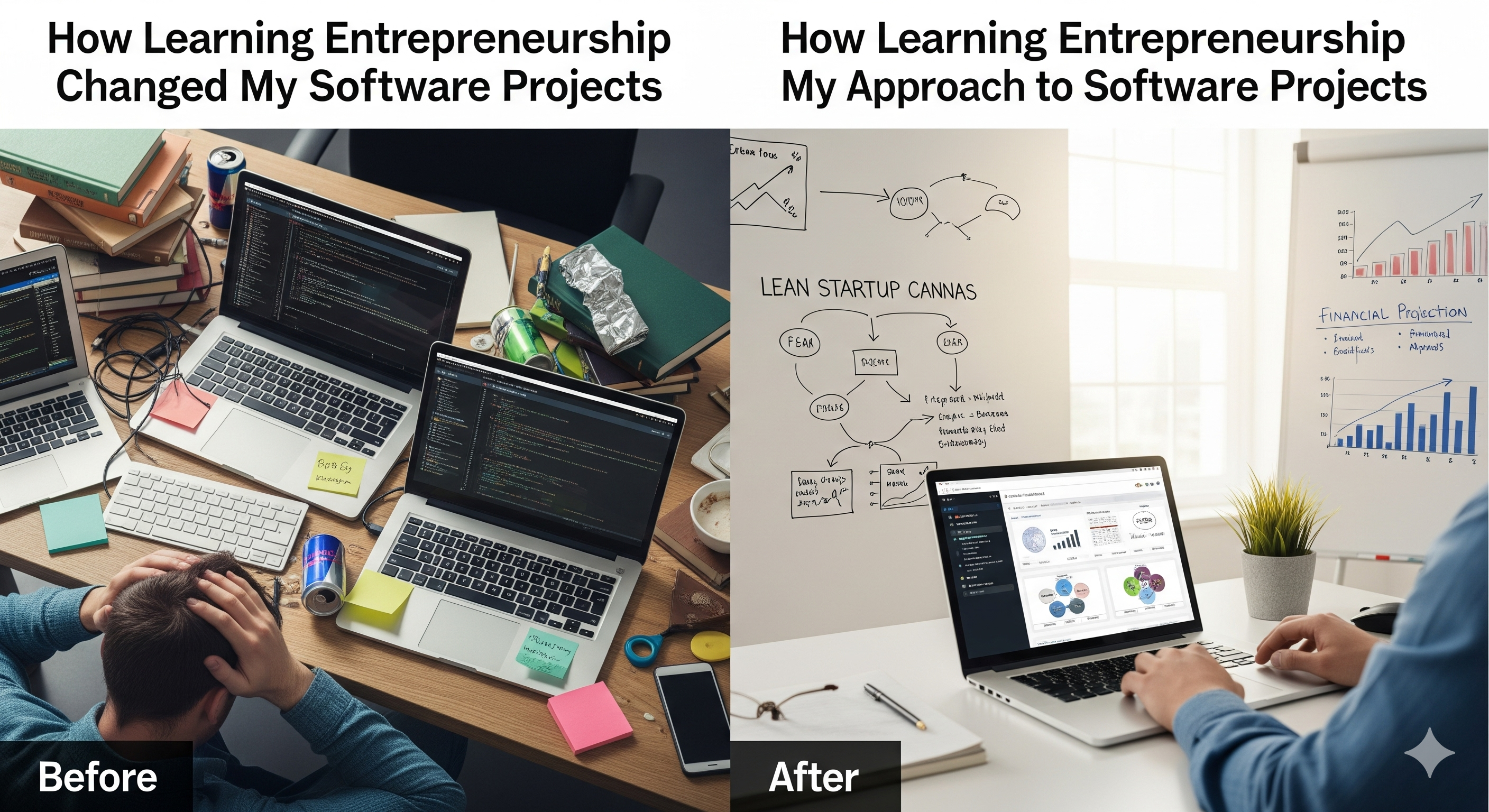
When I first started coding, my mindset was purely technical. My focus was on writing clean code, learning new frameworks, and solving problems with elegant algorithms. For me, success was measured in performance benchmarks, uptime percentages, or how neatly I could structure my backend.
But then I started studying entrepreneurship, and everything changed. Suddenly, I began to see software not just as code, but as a product. And products don’t live in isolation; they exist in the messy, unpredictable world of users, markets, and business realities.
This shift completely transformed the way I approach projects today.
Beyond Features and Code
As a developer, my instinct was always to add more features. The more I could build, the more valuable the project would be, right?
Wrong.
From an entrepreneurial perspective, features are only as valuable as the problems they solve. If users don’t care about a feature, it’s just noise, no matter how beautifully it’s engineered.
This realization pushed me to constantly ask:
- Who is this really for?
- Does it solve a real problem, or just scratch my itch as a developer?
- Will users pay for it, or at least care enough to use it consistently?
Thinking in Terms of Value
Entrepreneurship teaches you to measure value, not effort. A week spent polishing a feature nobody uses is wasted time. Meanwhile, a quick adjustment to improve onboarding or reduce friction in sign-ups could create huge impact.
I started shifting my focus from how do I build this? to why does this matter?
- Instead of obsessing over code optimization too early, I prioritized user experience.
- Instead of adding yet another microservice, I focused on making the existing workflow more reliable.
- Instead of building what was fun for me, I learned to build what mattered for others.
Building for Scalability in Two Dimensions
Entrepreneurship also gave me a new lens on scalability. As a backend developer, scalability used to mean server performance, queue management, concurrency control, and distributed systems.
But in business terms, scalability also means:
- Can this grow without my constant involvement?
- Can I onboard new customers without rewriting the whole system?
- Does the pricing model make sense as usage grows?
This forced me to design systems not just for technical resilience, but also for operational efficiency. Automating deployments, integrating DNS and CDN, and orchestrating workflows wasn’t just a technical challenge — it was also a way to make the product sustainable.
The Intersection of Code and Business
Studying entrepreneurship didn’t turn me into a businessperson who forgot how to code. Instead, it gave me a dual lens. Now, every decision I make in code has a business question tied to it:
- If I build this, will it attract or retain users?
- Does this reduce costs or increase revenue potential?
- Will this make the product easier to explain, sell, or support?
This perspective doesn’t replace technical excellence. It sharpens it. Because building something technically brilliant that nobody uses isn’t engineering — it’s art without an audience.
A Better Balance
Today, I still love solving technical challenges. I still get excited about designing message queues with RabbitMQ, orchestrating deployments, or experimenting with scaling strategies. But I no longer see those as ends in themselves.
They’re tools powerful ones in service of delivering value.
And that’s the biggest lesson entrepreneurship taught me: great software isn’t just built, it’s delivered with purpose.